A chandelier should make a room feel considered and luminous, not interrupt dinner with a restless shimmer. So, why does a chandelier flicker when the bulbs appear intact and the fixture was working perfectly yesterday? The answer can be as simple as an incompatible LED bulb or as serious as a loose electrical connection. The key is to recognise the pattern before attempting a fix.
A brief flicker when another high-power appliance starts is different from a chandelier that pulses continuously. Equally, one dim bulb points to a different cause than an entire fitting going dark for a second. Begin with the easy checks, then leave any work involving wiring, the ceiling rose or the chandelier’s support to a qualified electrician.
Why does a chandelier flicker? Start with the pattern
Before changing anything, observe when the flicker happens. Does it affect every lamp in the chandelier, or only one? Does it appear only when the lights are dimmed, after the fitting has been on for an hour, or when someone walks across an upstairs floor? These details narrow the likely cause considerably.
If a single bulb flickers, the issue is usually local to that bulb or its holder. If every light flickers together, look instead at the dimmer, switch, power supply or a shared connection. A chandelier on a long chain or suspended stem can also transmit slight movement, but movement alone should not make the illumination cut in and out.
Turn the light off at the wall before inspecting it. If you need to touch a bulb, allow it to cool first. For any investigation beyond the bulbs and visible fittings, isolate the circuit at the consumer unit and call an electrician rather than working around live electricity.
The most common causes of chandelier flickering
Loose or poorly seated bulbs
A bulb that has not made firm contact with the socket can flicker intermittently, especially in a multi-arm chandelier where small vibrations occur as doors close or the fitting is cleaned. With the power off and the bulb cool, gently tighten it. Do not force it: an overtightened screw cap can damage the holder or make later removal difficult.
Check for dust, corrosion or dark marks around the base of the bulb and inside the socket. A discoloured holder, a burnt smell or a bulb that feels unusually hot calls for professional attention. Replacing the bulb alone will not solve a damaged lampholder.
LED bulbs and dimmer incompatibility
This is one of the most frequent explanations in beautifully updated period homes. Traditional dimmers were designed for higher-wattage incandescent lamps. Modern LEDs use far less power and can behave unpredictably when paired with an older dimmer: flickering, flashing at low settings, buzzing or failing to turn fully off.
First, confirm that every bulb is dimmable. A non-dimmable LED should never be used on a dimmer circuit, even if it seems to work at first. Next, check that the dimmer is rated for LED loads and that the chandelier’s combined wattage falls within its minimum and maximum range. Mixed bulb types, mixed colour temperatures and LEDs from different ranges can also produce uneven results in a statement fixture.
A compatible LED dimmer often resolves the issue, but it should be fitted by an electrician. Some dimmers also have an adjustment setting for the minimum brightness level, which can stop flickering at the lowest end of the dimming range.
A failing bulb or driver
LED lamps contain small electronic components known as drivers. As a bulb ages, its driver can begin to fail long before the lamp stops working completely. The result may be a subtle pulse, occasional flash or reduced brightness.
Try replacing the affected bulb with a known compatible bulb of the same type and wattage. In a chandelier, it is worth replacing all lamps as a matched set when several are the same age. This creates a more consistent glow across crystal droplets, alabaster shades or sculptural metal arms, and prevents a patchwork of slightly different light colours.
Some integrated LED chandeliers do not use replaceable bulbs. Their driver may be housed in the ceiling canopy or within the fixture itself. If an integrated fitting flickers, do not dismantle it. The driver, wiring or control gear needs assessment by a qualified professional, ideally one familiar with decorative lighting installations.
A loose connection in the fitting or ceiling
If the whole chandelier flickers, particularly when the fitting moves or the room vibrates, a loose connection may be the cause. Connections can loosen over time through natural movement, previous installation work or heat cycles from lamps. This is not a cosmetic fault to ignore.
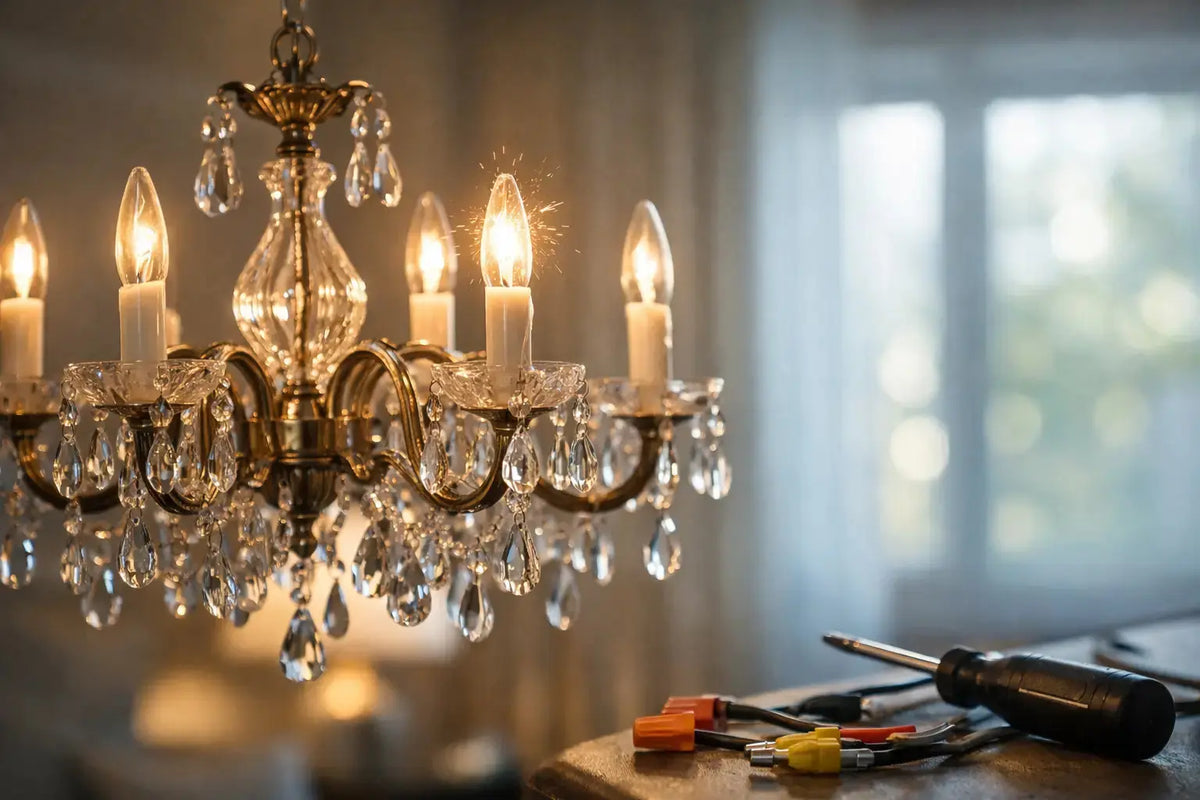
Warning signs include crackling, a buzzing sound that is new or pronounced, warmth at the ceiling canopy, scorch marks, a burning odour or a switch that feels hot. Turn the circuit off and arrange an electrician promptly. A chandelier is both an electrical fitting and a substantial decorative piece, so its wiring and mounting must be secure.
Voltage fluctuations and circuit load
A momentary flicker across several lights may be caused by a voltage dip elsewhere in the property. You may notice it when a shower pump, oven, washing machine or other high-demand appliance switches on. Occasional, very brief changes can happen, but regular or dramatic flickering deserves investigation.
If lights in more than one room are affected, the issue may sit at the consumer unit, a circuit connection or the incoming supply rather than the chandelier itself. Make a note of which rooms flicker and what appliances are running. This gives an electrician useful context and avoids replacing a perfectly good fixture for the wrong reason.
An ageing switch or dimmer
A worn wall switch can create an inconsistent connection, while an old dimmer may struggle with an LED upgrade. If the chandelier flickers when you touch the control, turn the dial or adjust the slider, the control is a strong suspect.
Do not rely on repeatedly toggling the switch as a workaround. Electrical faults tend to become less predictable, not more. Replacing a switch or dimmer is a relatively straightforward job for an electrician and can make a dramatic difference to daily comfort and ambience.
What you can safely check yourself
Homeowners can usually confirm whether the bulbs are secure, correctly specified and compatible with the dimmer. You can also test the chandelier at full brightness, where appropriate, to see whether the flicker occurs only during dimming. Keep a simple record of whether the issue affects one lamp or all of them.
Avoid removing the ceiling canopy, opening junction boxes, altering wiring or attempting to repair a damaged lampholder. Chandeliers are often heavier and more complex than standard ceiling lights, with multiple arms, fine wiring and delicate finishes. Protecting the fixture’s beauty means protecting its installation, too.
When flickering needs an electrician
Book professional help immediately if you see sparking, smell burning, hear crackling, notice heat around the fitting, or experience repeated tripping at the consumer unit. The same applies if the chandelier flickers across all bulbs after you have checked the lamps and dimmer compatibility.
It is also sensible to call an electrician after installing a new, heavier chandelier if flickering starts soon afterwards. The issue may be unrelated to the fixture’s design, but the mounting point, electrical connection and control should all be checked as one installation. A luxury chandelier deserves a secure, properly specified foundation.
Choosing bulbs that keep the light composed
For a calm, even result, select identical bulbs from the same range for every visible arm. Match the cap type, shape, wattage equivalent, dimmability and colour temperature. Warm white light generally enhances crystal, brass, smoked glass and natural stone finishes with a softer, more inviting character, while cooler light can suit a crisp contemporary scheme.
Consider bulb shape as carefully as brightness. Candle bulbs preserve the graceful profile of a traditional chandelier, while clear filament LEDs add sparkle without the energy use of older lamps. For modern designs with exposed globes, consistency is what makes the overall composition look intentional.
A flickering chandelier does not always signal a major fault, but it is never an effect worth accepting in a room designed for elegance. Start with the bulbs and dimmer, take warning signs seriously, and let a qualified electrician handle anything beyond those simple checks. Once the source is resolved, your chandelier can return to what it does best: giving the room a confident, beautifully layered glow.