A beautifully lit front door changes the feeling of arriving home. It gives a period façade more presence, makes a contemporary exterior feel considered after dark, and offers the practical reassurance of a clear, welcoming approach. Yet exterior wall lighting is rarely a purely decorative decision. The wrong fitting can look undersized beside a tall doorway, cast harsh glare across a terrace, or simply fail to withstand rain and frost.
To choose exterior wall sconces with confidence, begin with the wall, the setting and the experience you want to create. The finest choices bring together proportion, weather protection and a finish that feels at home with the architecture, whether your taste leans towards sculptural modern metalwork, traditional lantern forms or a refined statement in glass.
Choose exterior wall sconces by location
An entrance, side passage and garden seating area need different kinds of light. Before settling on a silhouette, stand outside after dusk and consider what the fitting needs to do. Is it there to make finding keys effortless, to frame the front door with a sense of occasion, or to create a softer pool of light for evening entertaining?
At a front entrance, a pair of wall sconces either side of the door creates a balanced, tailored look. This arrangement is especially effective on symmetrical façades and around doors with sidelights. A single fitting can work well where space is limited or where the architecture is deliberately asymmetrical, but it should be substantial enough to hold its own against the door and surrounding brickwork.
For side gates, utility doors and narrow paths, function leads. Choose a compact fitting with a broad, controlled beam that illuminates steps and locks without spilling intrusive light into neighbouring windows. On a terrace or covered veranda, decorative wall lights can be warmer and more atmospheric. They should complement rather than compete with pendants, chandeliers or table lamps visible through the glazing.
Garden walls call for restraint. Repeated small sconces can define an outdoor dining zone or guide movement through the space, but too many points of light flatten the garden and remove its sense of depth. Allow planted areas and darker corners to remain quietly shadowed.
Get the scale right before choosing a finish
A wall sconce may look generous in a product image yet disappear when placed next to a wide door, deep porch or tall rendered elevation. Scale is what makes exterior lighting feel intentional rather than added as an afterthought.
As a useful starting point, fittings beside a standard front door are often positioned with their centres around 1.65 to 1.8 metres above ground level. This generally places the light at a comfortable visual height while keeping the glow useful around the handle and threshold. For a pair, aim for a height that relates to the door hardware and any glazing rather than following a measurement blindly.
The fixture’s height also matters. A small, understated sconce can suit a compact cottage porch, while a large lantern-style design brings the required presence to a double-height entrance or grand portico. Where there is a canopy, check that the fitting has enough breathing room beneath it. A lantern pressed too close to a porch ceiling can look cramped and restrict downward illumination.
Do not overlook projection. A fitting that extends far from the wall has visual drama and can cast a generous wash of light, but it may obstruct a narrow path or become vulnerable near a busy driveway. Slim up-and-down lights suit contemporary elevations and confined spaces, although their precise pools of light may not be enough as the sole source at a main entrance.
A practical way to test proportion
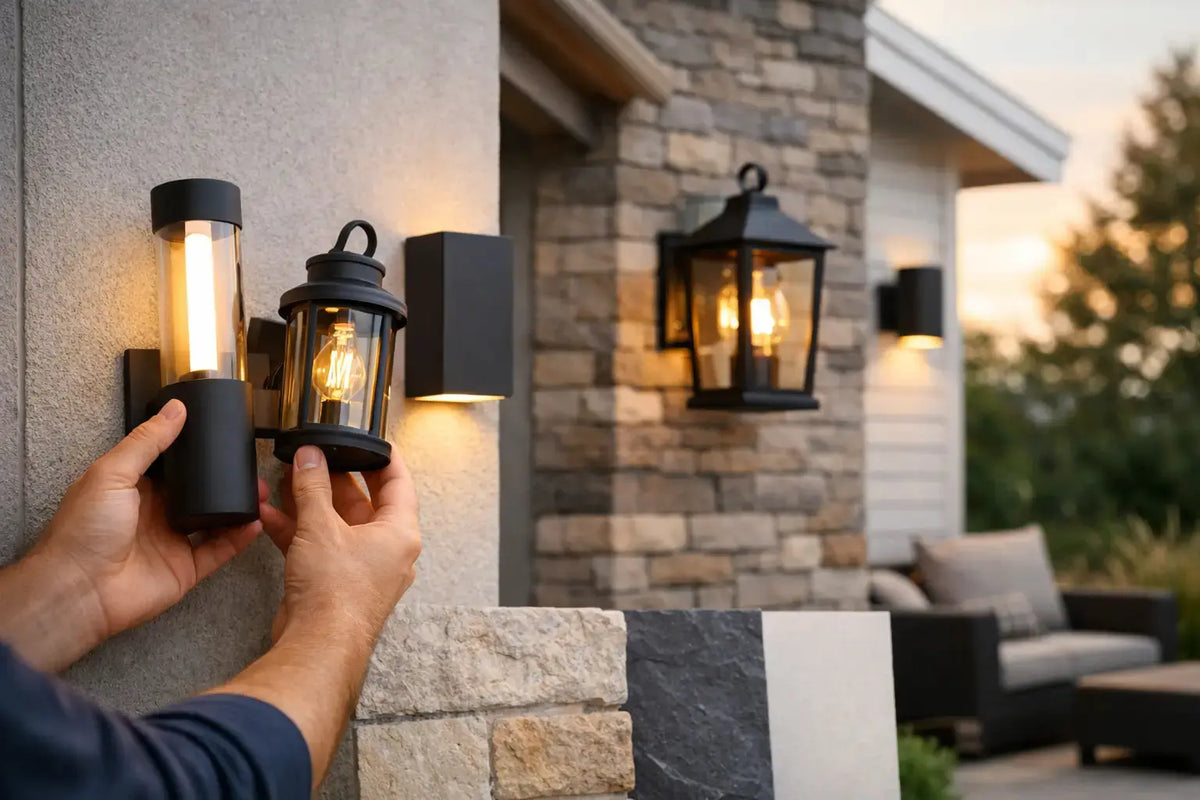
Make a simple paper outline of the sconce at its full dimensions and tape it to the wall. Step back to the pavement or the end of the drive, then view it from indoors as well. This inexpensive test reveals whether the design feels appropriately scaled long before installation.
Look beyond the style at the IP rating
Luxury should last beyond the first season. Exterior fittings must be selected for their exposure to the elements, not just their appearance. The IP rating indicates how well a light is protected against solid objects and moisture.
For a sheltered doorway or covered porch, IP44 is often a sensible minimum, offering protection from splashing water. A wall exposed to wind-driven rain, an open terrace or a garden boundary benefits from IP65 or above, which offers stronger resistance to dust and water jets. The exact requirement depends on placement and local installation guidance, so it is wise to confirm the rating against the conditions on your property.
Material is equally significant. Powder-coated aluminium offers a clean, contemporary look and is relatively easy to maintain. Solid brass develops a living patina over time, bringing character to coastal, heritage and garden settings, though it will not retain a newly polished appearance without care. Stainless steel can be crisp and practical, but quality matters, particularly in coastal areas where salt air accelerates corrosion.
Glass deserves attention too. Clear glass creates sparkle and allows a decorative filament bulb to become part of the composition, but it can expose dust, insects and water marks. Opal or seeded glass is more forgiving and diffuses the light beautifully. If your home faces a busy road, choose a design that conceals the bulb and softens glare.
Select light that flatters, rather than floods
Exterior lighting should make a home feel composed after dark, not overlit. The most inviting schemes combine enough brightness for safety with a warm colour temperature that complements stone, timber, brick and planting.
For front-door sconces, around 400 to 800 lumens per fitting is often sufficient, depending on the size of the entrance and the amount of existing ambient light. A wide, unshielded beam may require fewer lumens than a heavily shaded lantern. Pathways and side entrances may need more focused illumination, while a covered terrace benefits from gentler, diffuse light that supports conversation.
Choose warm white light, generally around 2700K to 3000K, for a more welcoming result. Cooler white light can make blue-grey render and modern metal finishes appear sharp, but it may feel clinical against traditional architecture. Dimmable fittings offer the most flexibility, particularly around terraces that move from family suppers to relaxed late-evening drinks.
Consider controls early. A dusk-to-dawn sensor provides effortless evening illumination, while a motion sensor is useful at side doors and garages. At the front of the house, motion activation alone can feel abrupt. Pairing it with a low-level timed setting, where possible, gives the entrance a more polished presence.
Create a coherent exterior scheme
Wall sconces do not have to match every metal finish around the house exactly. What matters is that they belong to the same design story. A matte black fitting can provide elegant contrast against pale stone, white render or warm timber. Aged brass feels especially at ease with traditional brick, dark-painted doors and rich garden greenery. Bronze offers depth without the formality of black, while polished nickel can lend a more tailored, metropolitan character to a covered entrance.
If there are indoor wall lights or a foyer chandelier visible from outside, use them as a visual cue. Matching every detail can feel overdone, but repeating an element such as clear ribbed glass, soft opal globes or warm brass creates a considered transition between interior and exterior spaces.
For larger homes, vary the scale without abandoning the family resemblance. A statement lantern might frame the main entrance, with smaller sconces in the same finish at side doors and a compact version near the garden gate. This creates hierarchy and keeps the exterior from feeling like a catalogue display.
Installation details that protect the finished look
Even an exquisite fitting can disappoint if the installation is poorly planned. Check the wall construction, cable route and fixing points before ordering. Heavy lanterns may require more substantial support than lightweight aluminium sconces, and uneven stone or textured brick can affect how neatly the backplate sits.
Exterior electrical work should be assessed and completed by a qualified electrician in line with current UK requirements. They can advise on appropriate circuit protection, cable routing, sensor placement and the suitability of the fitting’s rating. It is also worth asking them to position the lights before final fixing so you can confirm alignment from the drive and at the door itself.
Leave enough access for bulb replacement and occasional cleaning. This is particularly relevant with enclosed lanterns, which can be beautiful but less convenient if mounted high above a doorway. Integrated LED designs offer a clean, modern profile and long service life, while replaceable bulbs provide more freedom to alter warmth and brightness later.
The best exterior wall sconces do more than brighten a wall. They give the architecture a nighttime identity, make everyday arrivals feel more gracious, and let the character of your home continue well beyond the threshold.